
Keyword Research Techniques
11 Min
Keyword Research Techniques
The five keyword research techniques that work after the semantic shift, and how to connect them into a content strategy.
March 16, 2026

Co-Founder

Co-Founder
Contents
Most guides on keyword research techniques walk you through the same process. Pick a tool, enter a seed keyword, filter by volume and difficulty, export the list. The process works. But it skips the question that matters most for practitioners today: why did keyword research evolve from matching keywords to mapping topics, and what does that mean for which techniques actually work?
The answer starts with a structural change in how search engines retrieve information. That change reshaped every technique in the keyword research playbook. The techniques themselves are not new, but understanding why they work differently now is what separates a keyword list from a content strategy.
This article covers the purpose of keyword research, the infrastructure shift that changed it, the types of techniques available and what each one accomplishes, how AI fits into the process, and what keyword research looks like when content scaling connects the techniques rather than running them in isolation.
What Is the Main Purpose of Keyword Research?
The standard definition is straightforward. Keyword research is the process of finding search terms that people enter into search engines so you can target those terms in your content. That definition is accurate, but it describes the mechanism rather than the purpose. It is the 2015 version.
The purpose of keyword research has not changed. It is the process of understanding what your audience needs and how they express those needs when they search. The keyword list was always a means to that understanding, not the end product. What has changed is that the list itself no longer drives rankings the way it once did. Search engines no longer reward pages for containing the right keywords. They reward pages for satisfying the intent behind the search. The purpose was always demand intelligence. The output has caught up to the purpose.
Three things keyword research produces that nothing else replaces.
- It reveals demand. You cannot build a content strategy without knowing what people want to know. Keyword research is how you see the shape of demand in your market. What questions do people ask? What problems do they need solved? What language do they use to describe those problems? No amount of internal brainstorming substitutes for looking at what people actually search for.
- It exposes intent. The same topic searched with different phrases signals different needs. "CRM software" is a different audience at a different stage than "best CRM for small nonprofits." Keyword research is how you see those differences and plan content that serves each one. Without it, you are guessing which audience you are writing for.
- It identifies opportunity gaps. Where competitors have not published, where difficulty is low, where demand exists without adequate supply. This is strategic intelligence that tells you where you can win. A keyword gap analysis provides a view of the competitive landscape that no other process delivers.
The distinction matters because practitioners who define the purpose as "find keywords to rank for" are doing a narrower version of the process than practitioners who define it as "understand the demand landscape and map it to content opportunities." The techniques that follow serve the broader definition.
Why Keyword Research Became Topic Research
The single most important change in keyword research over the past decade is the shift from lexical search to semantic search. This is the infrastructure change that reshaped every technique. Every guide tells you to "focus on topics" and "target intent," but almost none explains the underlying reason those recommendations exist.
Lexical search matched strings. For decades, search engines worked by matching the words in a query to the words on a page. The system built an index of every word on every page, and when a user searched, it found pages containing those words and ranked them by relevance signals like backlinks and page authority. Keyword research under this model was about finding the right strings to place in your content. The keyword was the unit of optimization. If you wanted to rank for "best running shoes," your page needed to contain that exact phrase.
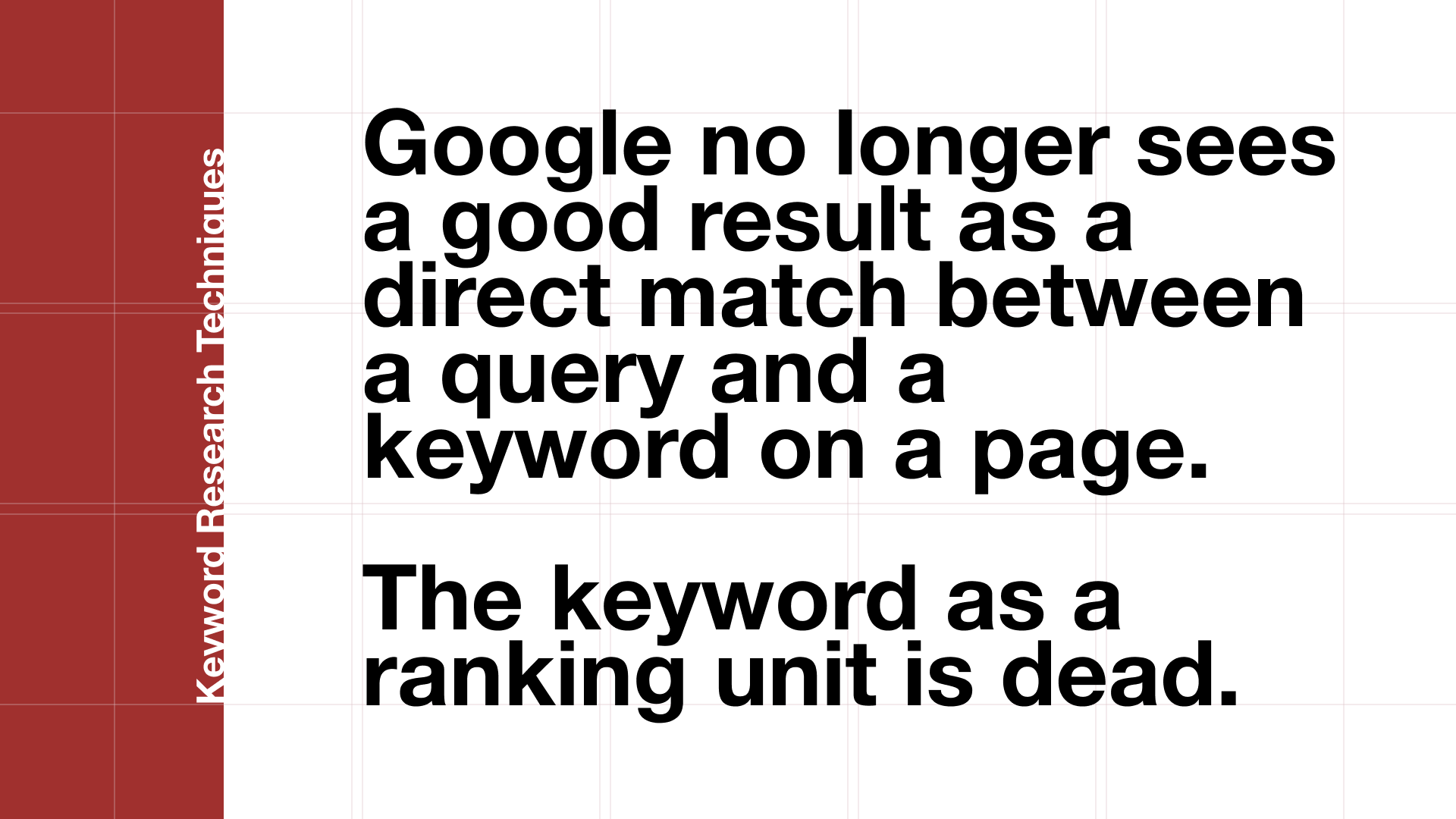
Semantic search matches meaning. Google's Knowledge Graph grew from 18 billion facts in 2012 to 500 billion by 2020, building a structured map of entities and information gain that gave the search engine a structured map of concepts, entities, and relationships. Hummingbird (2013) enabled Google to interpret the meaning of a full query rather than processing individual keywords. RankBrain (2015) applied machine learning to understand queries Google had never seen before. BERT (2019) allowed Google to understand the relationship between words in a sentence, so that "running shoes for flat feet" and "shoes for runners with low arches" could be recognized as the same need. MUM (2021) extended that understanding across languages and formats. Google no longer sees a good result as a direct match between a query and a keyword on a page. The keyword as a ranking unit is effectively dead. It matches the searcher's intent to the content's ability to satisfy it.
The unit of optimization shifted from keyword to topic. When the search engine understands meaning, targeting a single keyword is less valuable than demonstrating comprehensive understanding of a topic. One topic covers dozens of keyword variations. A page that thoroughly addresses a topic will rank for queries that never appear in any keyword tool, because the search engine understands that the page's content satisfies those queries even without exact keyword matches. This is why keyword research evolved into topic research. The mechanical process of finding keywords still exists, but it feeds into a larger process of mapping topics, understanding entity relationships, and building the kind of topical authority that search engines now reward.
We have written about this shift in detail. Increasing brand visibility in AI search now depends on citations rather than keyword matches. Our topical authority tool maps the three pillars of AI search (keywords, intent, and expertise) so you can see where to build authority.
The practical implication for keyword research techniques is direct. Every technique described below still works, but its value comes from serving the topic-first model, not the keyword-matching model. Techniques that help you understand demand, map intent, and identify topic gaps are more valuable than techniques that help you find exact-match keywords to place in your content.
What Are the Types of Keyword Research?
Most guides organize keyword research techniques by tool or by step number. A more useful framework organizes them by what they accomplish. Five categories cover the full range of keyword research techniques, and each serves a different function in the topic-first model.
Demand discovery is the process of finding what your audience searches for. The core techniques are seed topic expansion using tools like Semrush, Ahrefs, or Google Keyword Planner, where you enter broad topics and filter the suggestions by relevance, word count, and difficulty. Google Search Console mining is equally important and underused. GSC shows which queries already trigger impressions for your pages, revealing demand you have relevance for but have not deliberately targeted. Community monitoring fills another gap. Social platforms, forums, and support tickets surface the language your audience actually uses, which often differs from the language keyword tools suggest. The best demand discovery combines tool-generated data with first-party data from your own site and audience.
Intent mapping is the process of understanding what the searcher actually needs. The primary technique is SERP analysis. Search your target keyword and look at what ranks. Does Google show blog posts, product pages, comparison tables, or tools? The format Google rewards tells you what the searcher expects. A keyword where Google shows product pages will not rank a blog post, regardless of optimization. Intent classification (informational, navigational, transactional, commercial investigation) provides a useful starting framework, but the SERP is the ground truth. Query modifier analysis adds another layer. How a searcher phrases the same topic reveals their stage in the decision process. "What is CRM" is early-stage informational. "Best CRM for small nonprofits" is late-stage commercial. The same topic requires different content for different intent.
Competitive gap analysis is the process of finding where you can win. Competitor keyword analysis shows what they rank for that you do not, revealing topics you may have missed entirely. Difficulty evaluation goes beyond the score by examining who actually holds the top positions. If the top results are thin content from low-authority sites, the opportunity is real. If established sites with deep, comprehensive content hold every position, the difficulty score may understate the challenge. Content gap identification looks for topics in your space that no one covers well. The gap analysis is where opportunity lives, because it tells you where demand exists without adequate supply.
Long-tail and low-volume discovery is the process of finding specific, underserved queries. Long-tail keywords (typically three or more words) have lower individual volume but higher specificity and often higher conversion intent. Zero-volume keywords are queries that tools report as having no search volume but that generate real traffic. These appear in GSC data, community discussions, and AI prompt patterns. In the AI era, this category has expanded significantly. AI prompts average 25 or more words according to Graphite's AEO research, creating a long tail roughly 4x larger than the traditional SEO long tail. That demand will never appear in conventional keyword tools but represents a growing share of how people seek information.
Alignment monitoring is the process of checking whether your content still matches the demand landscape. Most teams treat keyword research as a project that happens quarterly or when someone remembers to schedule it. Alignment monitoring makes it continuous. The techniques include cluster-level impression tracking (aggregating GSC data by topic rather than by individual keyword to see whether your topic coverage is gaining or losing relevance), ranking stability monitoring (pages that decline without a corresponding algorithm update signal that the demand landscape has shifted), and query-page alignment scoring (measuring whether each page serves the intent behind the queries it actually receives). This is the category most teams skip entirely, and it is the category that prevents strategy drift between research sessions.
Is AI Good for Keyword Research?
The direct answer is that AI is good at the mechanical parts of keyword research and insufficient for the strategic parts. That distinction maps cleanly to the semantic shift.
What AI does well. Generating keyword suggestions, expanding seed topics into related queries, identifying semantic variations, and producing initial keyword lists. These are the tasks that defined keyword research in the lexical era, when the process was fundamentally about finding strings to match. AI commoditized them. Anyone with access to ChatGPT can produce a keyword list in minutes. The list was never the valuable output of keyword research. The analysis that follows the list is where the value lives.
What AI does not replace. First-party demand data from Google Search Console, SERP-level intent analysis that requires actually searching and evaluating the results, competitive gap identification that depends on understanding your specific market position, and the strategic judgment of what to prioritize given your resources and goals. These are the semantic-era tasks. They require context, business understanding, and data that AI tools do not have access to. An AI model can tell you that "keyword research techniques" has related queries. It cannot tell you that your site has existing relevance for those queries, that a competitor just published a comprehensive guide targeting them, or that the intent behind them shifted last quarter.
Where AI changes the landscape. The demand landscape has fragmented across Google, AI assistants, social platforms, and voice search. A joint OpenAI and Harvard study found that roughly one-third of AI prompts represent entirely new information-seeking behaviors that never existed in Google search. Those queries will never appear in Ahrefs or Semrush. AI has not made keyword research unnecessary. It has expanded the territory that keyword research needs to cover while making the mechanical parts trivial. The techniques that matter most now are the ones AI cannot do for you: understanding your own data, evaluating competitive dynamics, and making strategic decisions about where to invest your content resources.
What Keyword Research Looks Like After the Semantic Shift
The techniques described above cover what keyword research needs to accomplish. In practice, those techniques are spread across disconnected tools and performed as periodic projects. Demand discovery happens in one tool, intent mapping happens by searching manually, competitive analysis happens in a third tool, and alignment monitoring does not happen at all. The semantic shift changed what keyword research needs to do. The operational problem is that most workflows have not caught up.
The disconnect matters because the topic-first model requires techniques to work together. Demand discovery that does not connect to intent mapping produces keyword lists without context. Competitive gap analysis that does not connect to alignment monitoring finds opportunities that go stale before you act on them. Each technique in isolation produces a partial view. The techniques only produce strategic intelligence when they feed the same system.
forecast.ing is built for this reality. The unit is the topic, not the keyword. Topics surface with strategic context already attached, so demand discovery, competitive positioning, and trend signals are visible in the same view rather than assembled from separate tools. The output is not a keyword list. It is a strategic brief and a full draft with citations. The five categories of techniques described in this article, from demand discovery through alignment monitoring, operate continuously in one system rather than across disconnected tools on a quarterly schedule.
The result is that keyword research becomes an ongoing input to content strategy rather than a periodic project. Content decisions reflect the full demand landscape rather than one analyst's keyword session. The techniques are the same ones described throughout this article. The execution connects them.
The direction of keyword research techniques is clear. From keywords to topics. From periodic projects to continuous monitoring. From isolated lists to connected intelligence. The techniques that work are the ones that reflect the reality the semantic shift created. The search engine understands meaning. The keyword research process needs to match that understanding.
Frequently Asked Questions
Semrush, Ahrefs, Moz, and Google Keyword Planner are the standard tools for keyword discovery, with each offering volume data, difficulty scores, and intent classification. Google Search Console is the most underused tool because it shows first-party data about what your audience actually searches. Forecast.ing surfaces keywords before they get discovered. The best approach combines multiple tools rather than relying on one.
Keyword research reveals demand (what your audience wants to know), exposes intent (how different phrasing signals different needs at different stages), and identifies opportunity gaps (where competitors have not published or supply is inadequate). These are the three outputs that nothing else replaces.
The shift from lexical to semantic search changed the unit of optimization from keyword to topic. Google now understands meaning through entities and relationships rather than matching strings, so demonstrating comprehensive understanding of a topic matters more than targeting individual keywords. Keyword research techniques still apply but now feed into topic mapping and topical authority building.
AI commoditized the mechanical parts of keyword research (generating lists, expanding seed topics) while leaving the strategic parts untouched (evaluating intent, identifying gaps, making prioritization decisions). AI has also expanded the territory keyword research needs to cover, since roughly one-third of AI prompts represent entirely new information-seeking behaviors that keyword tools will never capture.
You might also like
Browse all articles
Keyword Research Techniques
5 Min
Is Keyword Research Still Important in the AI Era?
What has changed about keyword research, what has not, and why the process matters more now than the keywords.
Keyword Research Techniques
4 Min
Improve SEO with Keyword Intent Understanding
How understanding keyword intent improves rankings, content alignment, and conversion — with practical examples.