
Keyword Research Techniques
4 Min
Can You Explain How Understanding Keyword Intent Can Improve My SEO Results?
How understanding keyword intent improves rankings, content alignment, and conversion — with practical examples.
March 16, 2026

Co-Founder

Co-Founder
Contents
Keyword intent is the reason behind a search query. When your content matches that reason, search engines reward you with rankings, clicks, and conversions. When it doesn't, you attract traffic that bounces.
This connection between intent and SEO performance is well established. The harder question is how to apply it across hundreds or thousands of keywords. This article covers how intent alignment drives specific SEO outcomes, then shows how to group keywords by intent so the insight becomes a workflow. Content scaling without intent alignment produces pages that rank but never convert. This article is part of our search intent tool series within the broader keyword research techniques pillar.
What Is Keyword Intent in SEO?
Keyword intent is what a searcher wants to accomplish. Someone searching "what is keyword intent" wants to learn. Someone searching "Semrush pricing" wants to buy. The intent determines what type of content should exist for that query.
The 3 C's framework gives you a practical way to match content to intent:
- Content type. What format does the SERP reward? Blog posts, product pages, landing pages, videos.
- Content format. Within that type, what structure works? Listicle, how-to guide, comparison table, tutorial.
- Content angle. What specific perspective or hook do top results use? "For beginners," "in 2026," "step by step."
Search your target keyword and check what ranks. If the top results are long-form guides, Google has determined the intent is informational. If product pages dominate, the intent is transactional. Publishing the wrong content type for the intent is one of the most common reasons pages don't rank. A listicle ranking for a "best" query earns clicks because the format matches what the searcher expects. A product page ranking for the same query gets skipped, no matter how good the product is.
How Does User Intent Impact Keyword Selection?
Most keyword research starts with volume and difficulty. Teams find high-volume keywords with low competition and build content around them. Intent gets checked later, if at all.
That order is backwards. A high-volume keyword where your content can't serve the searcher's intent is a worse pick than a lower-volume keyword where your expertise matches exactly what the searcher needs.
Consider "CRM software." The volume is massive. But if your product is a CRM for real estate teams, the intent behind that broad keyword spans dozens of use cases you don't serve. You'd rank for traffic that bounces. A keyword like "CRM for real estate agents" has lower volume, but the intent aligns with what you actually offer. The content you can create for it is stronger, the audience is more qualified, and the conversion path is shorter.
Intent should be a filter, not a checkbox. Before evaluating volume and difficulty, ask whether you can create content that genuinely serves what the searcher wants. If the answer is no, the keyword isn't worth targeting regardless of its numbers.
How to Group Keywords by Search Intent
Intent alignment drives results. But you can't analyze intent one keyword at a time when you're working with hundreds or thousands of them. Labeling each keyword as informational, navigational, commercial, or transactional is the starting point. The next step is grouping keywords that share the same intent into clusters.
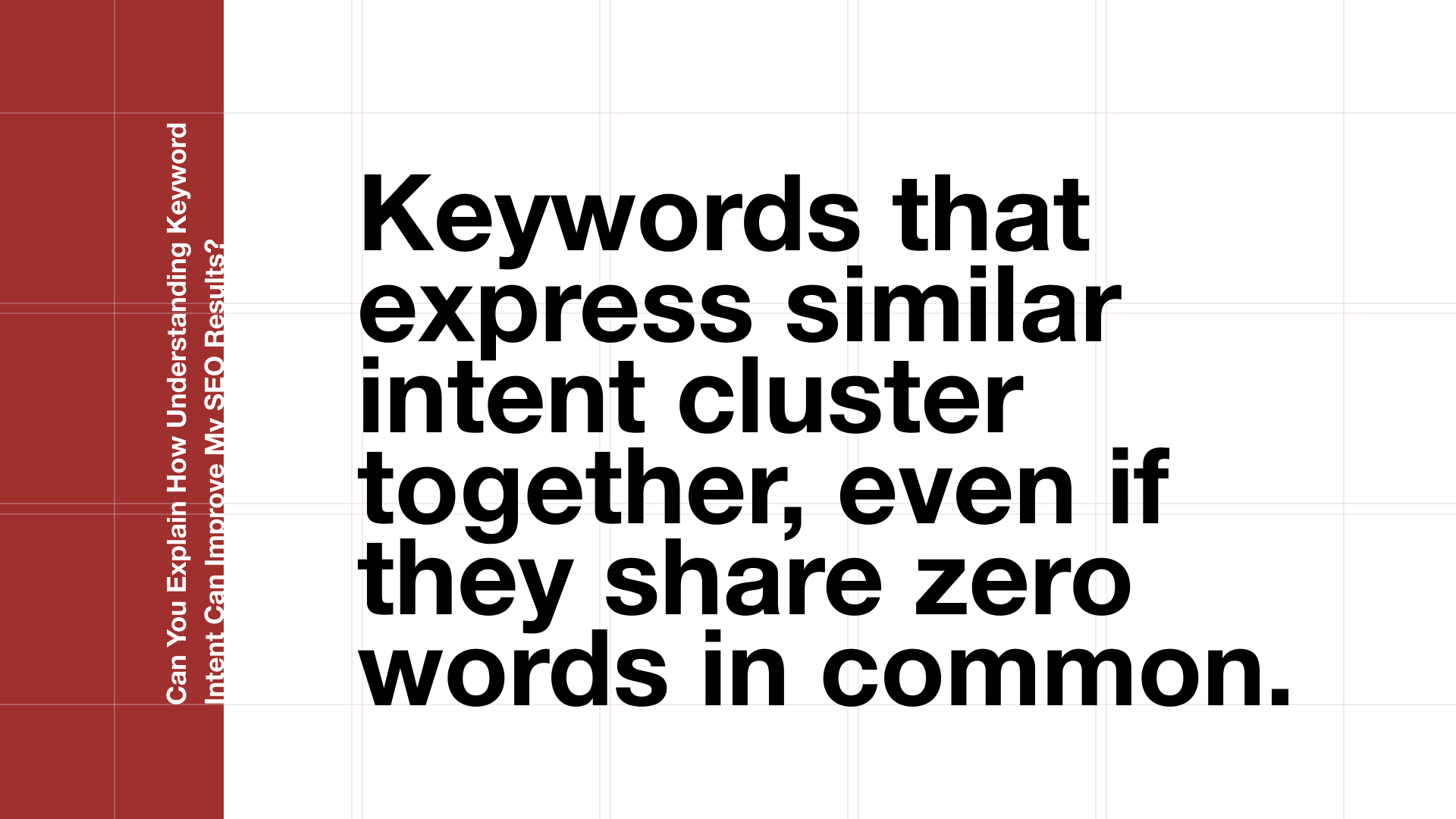
Forecast.ing's Google Search Console tool does this with your Google Search Console data. Upload your query export and it converts each keyword into a vector embedding, a numerical representation of meaning. Keywords that express similar intent cluster together, even if they share zero words in common. "Best running shoes for knee pain" and "supportive sneakers for joint issues" carry the same intent and end up in the same group.
The output is a set of intent-based topic clusters ranked by impressions, clicks, CTR, and average position. Each cluster represents a distinct audience need. Map your existing content to clusters and you see coverage. Find clusters with no content and you see gaps. That's where new content should go. Weekly analysis extends this across brand, competitive, and industry data.
This is how intent analysis becomes a content plan. Instead of guessing which topics to write about, you see where audience demand exists and whether your content meets it.
For a deeper look at the tools that support this workflow, see our guide to search intent tool.
Research Intelligence
This article was built from a live Forecast.ing topic report. The data below updates continuously, and when the conversation shifts enough, we get notified to refresh the content.
Understanding Search Intent
Executive Summary
Understanding Search Intent is the user goal behind a search query, the reason people look for information, products, or specific sites. Coverage focuses on expanded intent taxonomies, mapping intent to content format, and using behavioral and query signals for micro intent. Tensions surface between simple four bucket models and more granular lenses, and between keyword volume and intent alignment. This is for content strategists, SEOs, and product owners deciding content formats, funnel placement, and measurement. A common gap is prescriptive measurement standards for micro intent across channels.
- Generative Search Shift: Generative answers and AI driven search are compressing buyer journeys, making precise intent alignment essential for being selected or cited.
- Expanded Intent Types: Vendors and guides promote moving beyond four buckets, recommending multiple intent lenses and micro intent to boost visibility and conversions.
- Intent Signals Rise: Marketing and CRM playbooks urge tracking page level behaviors, demo views, pricing checks and on site flows as intent signals for activation.
- Probabilistic Search UX: Site search and retrieval pipelines are adopting intent classification, fuzzy matching, and intent weighted reranking to serve likely matches rather than binary results.
- How Should Content Format Vary By Search Intent?
- When Should We Prioritize Intent Over Keyword Volume?
- How Do You Map Micro Intent To Page Funnels?
- What Signals Best Predict Transactional Intent?
- How Will Generative Search Change Intent Measurement?
Frequently Asked Questions
The 3 C's are content type (blog post, product page, landing page), content format (listicle, how-to, comparison), and content angle (the specific perspective or hook top results use). Search your target keyword and check what ranks to identify all three before creating content.
Intent should come first. A high-volume keyword where your content cannot serve the searcher's intent will attract traffic that bounces, while a lower-volume keyword with strong intent alignment will convert at a higher rate. Evaluate whether you can genuinely serve what the searcher wants before looking at volume and difficulty.
Vector embeddings convert keywords into numerical representations of meaning, grouping queries that express similar intent even when they share no words in common. Tools like Query2Vector cluster your Google Search Console queries by semantic similarity, producing intent-based topic groups ranked by impressions, clicks, and CTR.
You might also like
Browse all articles
Keyword Research Techniques
5 Min
Is Keyword Research Still Important in the AI Era?
What has changed about keyword research, what has not, and why the process matters more now than the keywords.
Keyword Research Techniques
11 Min
Keyword Research Techniques for Semantic and AI Search
The five keyword research techniques that work after the semantic shift, and how to connect them into a content strategy.