
Keyword Research Techniques
3 Min
Are There Any Tools Available That Can Help Analyze Keyword Intent and Performance?
Discover effective tools to analyze keyword intent and performance for better SEO strategies.
March 16, 2026

Co-Founder

Co-Founder
Contents
Several tools can help you analyze keyword intent and track keyword performance. The standard options are Semrush, Ahrefs, and Moz. Each assigns intent labels and reports volume, difficulty, and ranking data.
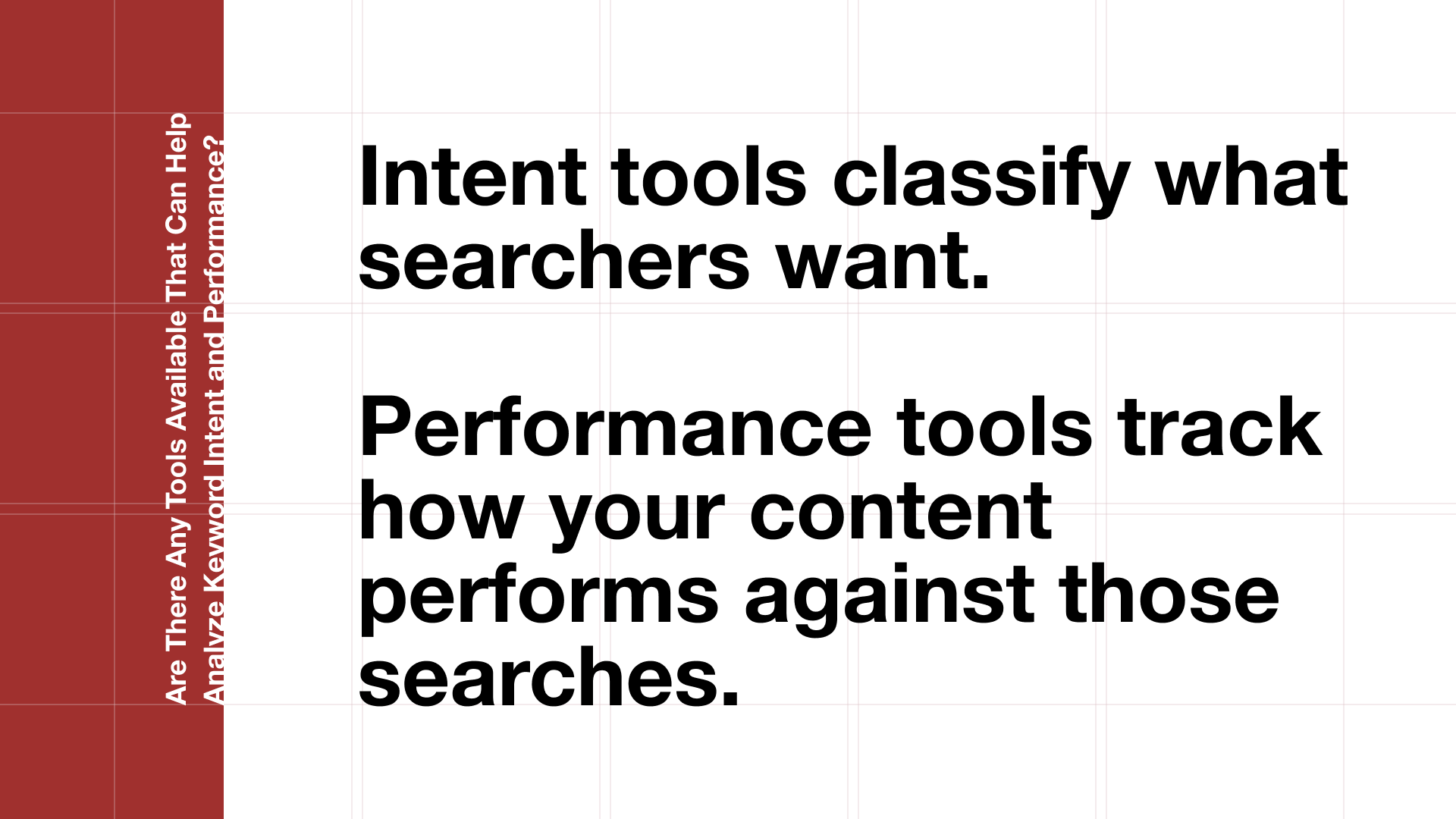
But keyword intent tools and keyword performance tools answer different questions. Intent tools classify what searchers want. Performance tools track how your content performs against those searches. This article covers both, then shows how Google Search Console bridges the gap between them. Content scaling depends on matching content to intent, not just picking keywords with high volume. This article is part of our search intent tool series within the broader keyword research techniques pillar.
What Tools Can You Use to Analyze Keyword Intent?
The major keyword research platforms all include intent classification. Here's what each one does:
Semrush. The Keyword Magic Tool labels every keyword with an intent tag: informational (I), navigational (N), commercial (C), or transactional (T). The Keyword Overview tool shows the intent widget alongside volume, difficulty, and a SERP preview. Semrush draws from 25+ billion keywords.
Ahrefs. Keywords Explorer uses AI to detect intent and lets you compare SERPs side-by-side. This is useful for spotting intent shifts over time. The "Clicks" metric shows whether a keyword actually drives traffic or gets answered in the SERP without a click.
Moz. Keyword Explorer clusters keywords and lets you build lists with custom relevance scores. The Rank Check feature shows whether you're on page one for your tracked terms.
These tools tell you what type of content the SERP rewards for a given keyword. That's the starting point for keyword intent analysis. The next question is whether your content actually matches what your audience searches for.
How Do You Analyze Keyword Intent with Google Search Console?
Semrush, Ahrefs, and Moz assign intent labels based on what's ranking in the SERP. That's useful for planning new content. But it doesn't tell you how your existing content performs against the intent behind the queries already driving traffic to your site.
Google Search Console captures that data. It logs queries that triggered an impression for your pages, along with clicks, CTR, and average position. This is first-party intent data. It shows what your audience actually searches when they find you, not what a tool predicts the average searcher wants.
The challenge is that GSC gives you a flat list of queries. A single page might attract hundreds of them. Some match the page's purpose. Others represent demand the page was never built to serve. You can't tell which is which by scanning keywords.
Forecast.ing's Google Search Console tool clusters your GSC queries by meaning, grouping semantically similar queries into topics ranked by impressions, clicks, and CTR. Each cluster shows a distinct audience need and whether your content serves it. Weekly analysis extends this across brand, competitive, and industry data.
How to Check Search Intent for Free
You don't need a paid tool to start analyzing keyword intent. These free options cover the basics:
- Google Search Console. Tracks impressions, clicks, CTR, and position for every query hitting your site. The best source of first-party intent data.
- Forecast.ing's query clustering tool. Clusters your GSC queries by meaning, as described above. Free to use.
- Google Trends. Tracks keyword popularity over time. Useful for spotting intent shifts and seasonal patterns.
- AnswerThePublic. Visualizes question-based keywords around a topic. Helps you understand informational intent patterns.
- Google autocomplete and related searches. Type your keyword into Google and read the suggestions. These reflect real search behavior and reveal adjacent intent patterns your tools might miss.
For a deeper look at how these tools fit into a broader intent analysis workflow, see our guide to search intent tool.
Research Intelligence
This article was built from a live Forecast.ing topic report. The data below updates continuously, and when the conversation shifts enough, we get notified to refresh the content.
Vector Search Techniques
Executive Summary
Vector Search Techniques convert text, images, audio and other data into numerical embeddings, then retrieve items by geometric similarity instead of keyword matching. Coverage emphasizes hybrid pipelines that fuse sparse methods like BM25 with dense embeddings, ANN index choices such as HNSW, and reranking strategies including cross encoder and RRF, exposing tradeoffs between precision, recall, latency and cost. This is for engineers and product managers choosing retrieval architecture and tuning production tradeoffs. A notable gap is widespread reliance on pure similarity without symbolic or ontology reasoning.
- Hybrid Retrieval: Production pipelines increasingly run BM25 and dense vector queries in parallel and fuse results with Reciprocal Rank Fusion to balance exact matches and semantic recall.
- Open Source Pipelines: New projects implement BM25 plus vector search, intent aware chunking and cross encoder reranking for local GPU retrieval, demonstrating vendor independent production stacks.
- Multimodal Embeddings: Multimodal embedding offerings now target audio, video, images and text, with practical guidance to prefer larger dimensions for quality and vector storage options like S3 Vectors for scale.
- Late Interaction Rerankers: Late interaction architectures and cross encoder rerankers are being used as middle grounds, trading higher scoring fidelity for controlled latency via candidate pruning and batching.
- How Should I Combine BM25 And Vector Search For Best Precision And Recall?
- When Should I Use HNSW Or ANN Indexes Versus Brute Force For My Dataset Size?
- What Are The Latency And Cost Tradeoffs Between Cosine Only And Cross Encoder Reranking?
- How Do Multimodal Embeddings Change Indexing And Metadata Design For Audio And Video?
Frequently Asked Questions
Google Search Console tracks every query hitting your site with impressions, clicks, and CTR data. Query2Vector clusters those queries by meaning at no cost. Google Trends, AnswerThePublic, and Google autocomplete also provide free intent signals.
Semrush tags every keyword with an intent label across 25+ billion keywords, Ahrefs uses AI-based intent detection with SERP comparison, and Moz clusters keywords with custom relevance scores. The best choice depends on whether you need bulk classification, SERP-level verification, or first-party data analysis.
Content that matches search intent ranks. Content that does not gets skipped regardless of domain authority or backlinks. Aligning content format and depth with the intent behind your target keywords is the most direct way to improve rankings and reduce bounce rates.
You might also like
Browse all articles
Keyword Research Techniques
5 Min
Is Keyword Research Still Important in the AI Era?
What has changed about keyword research, what has not, and why the process matters more now than the keywords.
Keyword Research Techniques
11 Min
Keyword Research Techniques for Semantic and AI Search
The five keyword research techniques that work after the semantic shift, and how to connect them into a content strategy.